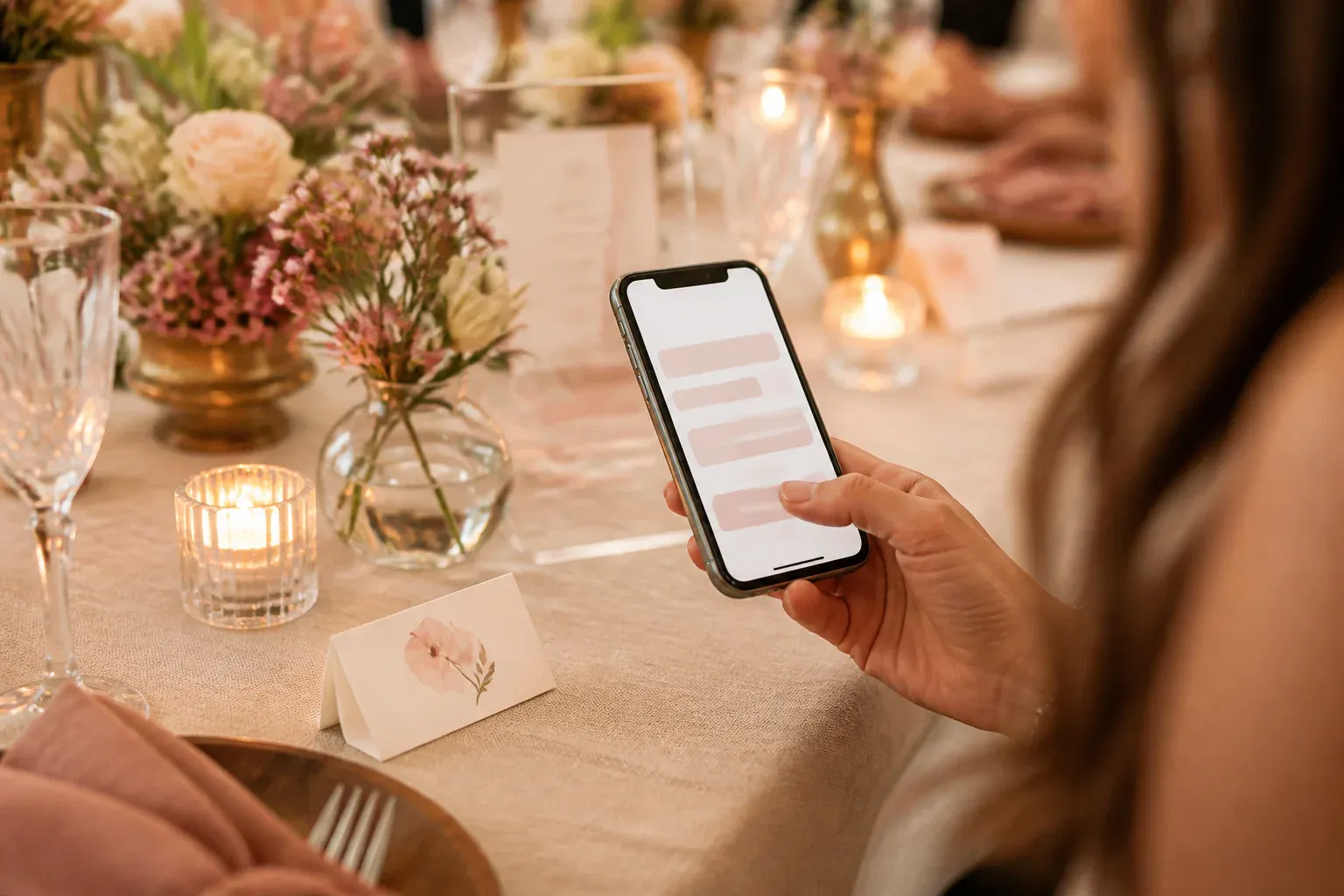
The paper guest book has a quiet problem: most guests never reach it, and the ones who do write “Congratulations!” while a queue forms behind them. The signatures are real, but the stories stay at the tables.
A digital guest book removes the queue and the pressure. Guests contribute from their own phones, in their own time, with as many words and photographs as they like. These are the formats that work, and how to decide between them.
1. A live message wall
The most complete replacement: guests scan a QR code, write a message, add a photo, and see it arrive on a venue screen. The room reads the messages together during the event instead of the hosts finding them alone weeks later.
This format suits any event where a screen is available. It also solves the empty-book anxiety—once the first few messages are visible, everyone understands what to do. If this is the direction you want, our digital guest book alternative page covers the details.
2. A photo-first wall
Ask specifically for pictures: the getting-ready photos, the table selfies, the moment the cake went slightly wrong. A collage-style display turns the evening’s camera rolls into a shared record while the event is still happening.
The trick is the prompt. “Add a photo from tonight” produces more contributions than a generic invitation to post.
3. A question of the hour
Change the prompt through the event. Start with “How do you know the couple?”, move to “What was your favorite moment of the ceremony?”, and end with “One piece of advice for the next ten years.” Rotating questions keep the wall fresh and give quieter guests an easy way in.
4. Messages from the people who couldn’t come
A digital guest book has no walls. Share the link with relatives abroad and friends who couldn’t travel, and their messages arrive during the event alongside everyone else’s. For many hosts this ends up being the most moving part of the wall.
5. A prediction book
For weddings, baby showers, and graduations: ask for predictions. Where will they live in ten years? What will the baby’s first word be? Seal the wall after the event and replay it on the anniversary. The replay is the payoff—write the date in the calendar.
6. The advice column
One line of advice, signed. It works because it is specific and short, and because reading fifty pieces of advice from fifty different lives is genuinely affecting. Expect a mix of sincere and funny; both belong.
7. An audio or video book
Some venues set up a phone booth for voicemail-style recordings. It produces wonderful material but demands more from guests and from whoever edits the recordings afterwards. It pairs well with a written wall rather than replacing it—the wall catches the many, the booth catches the brave.
8. The hybrid: paper for the few, screen for the many
Keep a small paper book for guests who love handwriting, and run the live wall for everyone else. The book collects a dozen careful entries; the wall collects the room.
How to choose
Three questions settle it:
- Is there a screen? If yes, a live wall adds an experience during the event, not just an artifact after it.
- Who is in the room? If every generation attends, choose the format with the fewest steps—a link and a text box beats an app download every time.
- What do you want in ten years? If the answer is “the messages, in order, with the photos,” pick a format that saves and replays the complete collection.
Whatever format you choose, the difference between a sparse guest book and a full one is rarely the technology. It is a clear prompt, a visible code, and the first three messages already on the wall when guests arrive.